
Think about the last time a scent caught you off guard. Perhaps it was the crisp tang of crushed peppermint that instantly cleared your mental fog, or the warm, earthy aroma of lavender that made your shoulders drop after an exhausting day.
Scent is not merely decorative. It is a direct chemical signal to the brain.
Yet, in our modern world, real botanical scents have largely been replaced by laboratory-synthesized perfumes. We surround ourselves with synthetic air fresheners, body sprays, and scented detergents under the illusion that we are experiencing aroma. In reality, we are inhaling petroleum derivatives that trick the nose while offering zero wellness benefits to the body.
To understand why true natural aromatherapy works—and why synthetic fragrances fall flat—we need to look deep inside the human brain.
The Olfactory Expressway to the Limbic System
Unlike sight, touch, or sound, the sense of smell bypasses the logical, analytical parts of your brain entirely.
When you hear a sound or see an object, that information travels first to the thalamus for processing. Smell takes a shortcut.
                  THE OLFACTORY PATHWAY
┌────────────────────────────────────────────────────────┐
│  Aroma Molecules Inhaled                               │
│            │                                           │
│            ▼                                           │
│  Olfactory Receptors (Nasal Cavity)                    │
│            │                                           │
│            ▼                                           │
│  Olfactory Bulb (Direct Neural Connection)             │
│            │                                           │
│            ├──────────────────────────┐                │
│            ▼                          ▼                │
│        Amygdala                   Hippocampus          │
│   (Emotional Response)        (Memory Formation)       │
└────────────────────────────────────────────────────────┘
When volatile aromatic compounds enter your nasal cavity, they bind to millions of olfactory receptors. These receptors send immediate electrical impulses directly along the olfactory nerve straight to the limbic system—the brain’s primitive center for emotional regulation, memory, and autonomic nervous system control.
The Key Limbic Structures
The Amygdala: The emotional processing center. A single whiff of a soothing botanical can instantly quiet an overactive "fight-or-flight" response here.
The Hippocampus: The seat of long-term memory. This direct link explains why scents trigger vivid emotional memories faster than visual images.
The Hypothalamus: The master regulator of hormone production, sleep cycles, and heart rate. Aromatic compounds can directly signal the hypothalamus to lower cortisol levels.
When you inhale genuine plant chemistry, you are not just "smelling" something pleasant. You are delivering a fast-acting biochemical command to your nervous system.
True Aromatherapy vs. Synthetic Perfumes: The Chemical Divide
Why can’t a synthetic "Lavender-Scented" room spray replicate the therapeutic effects of pure lavender essential oil? Because your brain knows the difference between complex living chemistry and cheap synthetic imitations.
      SYNTHETIC FRAGRANCE               NATURAL ESSENTIAL OIL
  ┌──────────────────────────┐      ┌──────────────────────────┐
  │ Single Synthetic Molecule│      │ 200+ Synergistic         │
  │ (e.g., Linalyl Acetate)  │  vs  │ Botanical Compounds      │
  │                          │      │                          │
  │ Petrochemical Solvents   │      │ Active Terpenes &        │
  │ & Phthalates             │      │ Plant Defense Molecules  │
  └──────────────────────────┘      └──────────────────────────┘
The Illusion of Synthetic Perfumes
Synthetic fragrances are engineered in laboratories using petroleum derivatives, benzene rings, and synthetic aldehydes. A chemist might isolate a single scent molecule—like synthetic linalyl acetate—to mimic the surface smell of lavender.
However, synthetic molecules lack the organic complexity of real plants. Furthermore, commercial perfumes are loaded with phthalates (chemical fixatives that make scents linger) and synthetic alcohol carriers. Instead of supporting wellness, synthetic perfumes often trigger:
Dull tension headaches and migraine flare-ups.
Sinus irritation and upper respiratory inflammation.
Endocrine disruption caused by phthalate exposure.
The Synergy of Natural Plant Chemistry
In contrast, a single drop of pure, steam-distilled lavender essential oil contains over 200 distinct, naturally occurring botanical compounds—including linalool, linalyl acetate, terpinen-4-ol, and lavandulol.
These compounds work in natural synergy. While linalool calms the nervous system, terpenes enhance bioavailability and absorption. Pure essential oils interact with your biology as functional tools rather than toxic irritants.
Comparing Your Options: Botanical vs. Lab-Made
| Feature | Pure Botanical Essential Oils | Synthetic Perfumes & Sprays |
| Source Material | Cold-pressed or steam-distilled plants | Petroleum derivatives & lab chemicals |
| Brain Impact | Direct limbic system stimulation & calm | Tricks olfactory nerve; no wellness benefit |
| Active Ingredients | Hundreds of synergistic plant terpenes | Single isolated aromatic molecules |
| Common Additives | None (in 100% pure formulations) | Phthalates, synthetic alcohols, parabens |
| Body Response | Modulates stress, focus, and breathing | Potential headaches, hormone disruption |
Functional Tools for Everyday Wellness: Naturayas
Understanding the neuroscience of scent is one thing; weaving it into a busy modern routine is another. You shouldn't need a complex laboratory setup to benefit from aromatherapy during a hectic workday.
This is where Naturayas Essential Oils and Aroma Roll-Ons shine. Formulated with 100% pure, ethically sourced botanical extracts diluted in light, skin-friendly carrier oils, they turn ancient plant wisdom into portable daily tools.
1. Reclaim Calm: Naturayas De-Stress Aroma Roll-On
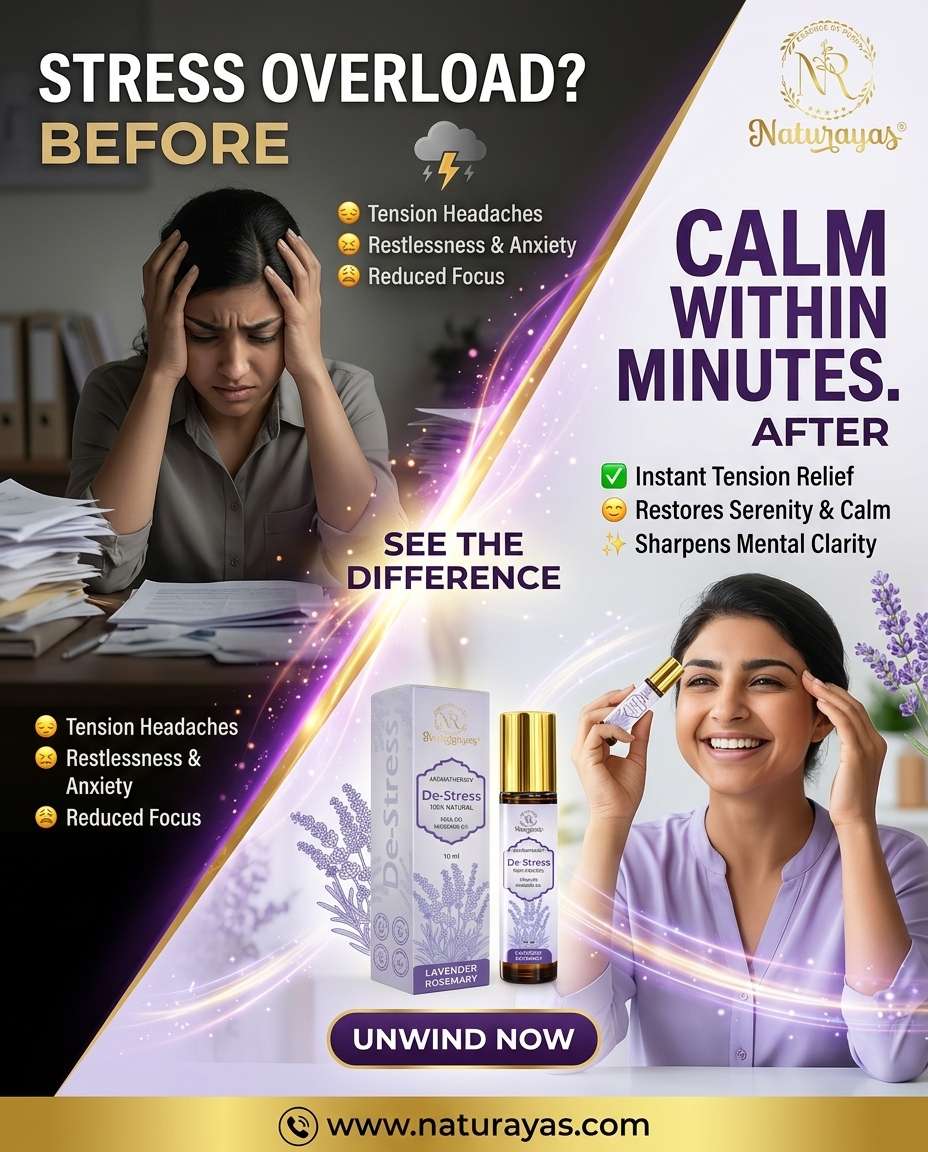
When work deadlines stack up and anxiety tightens your chest, your sympathetic nervous system is running the show. The Naturayas De-Stress roll-on combines therapeutic-grade Lavender, Chamomile, and Bergamot essential oils.
How to Use: Glide the rollerball over your wrist pulse points, temples, and behind the ears.
The Mechanism: Warm skin activates the volatile terpenes. As you inhale, bergamot and lavender signal the amygdala to downregulate cortisol production, shifting you back into a calm, centered state.
2. Open Your Airways: Naturayas Breathe Easy Aroma Roll-On
Stale indoor air, seasonal shifts, and long hours staring at screens can leave your head feeling heavy and your breathing shallow. The Naturayas Breathe Easy blend harnesses the clarifying power of Eucalyptus, Peppermint, and Tea Tree oils.
How to Use: Apply directly to the collarbones, chest, or palms. Cup your hands over your nose and take three deep belly breaths.
The Mechanism: Natural 1,8-cineole (the active compound in eucalyptus) acts as a natural bronchodilator, opening respiratory pathways, while peppermint menthol stimulates cold receptors in the nasal passages for an instant burst of mental clarity.
How to Build a Daily Olfactory Routine
Transitioning from synthetic perfumes to functional aromatherapy is a simple, rewarding habit.
1.Morning: Desk & Workspace Preparation:Kickstart Mental Focus.
Add 4-5 drops of Naturayas Peppermint or Lemongrass Essential Oil to a cold-water diffuser at your desk to enhance alertness without coffee jitters.
2.Midday: On-the-Go Reset:Reset During High Stress.
Keep Naturayas De-Stress in your bag or pocket. When tension peaks, apply to wrists and inhale deeply for 30 seconds to break the stress cycle.
3.Evening: Wind-Down Ritual:Signal Sleep Readiness.
Apply Naturayas Breathe Easy or Lavender to your chest and soles of your feet 20 minutes before bed to prepare your brain for restorative sleep.
But What If You Could Scent Your Workspace Without Electricity or Water?
Diffusion is wonderful, but traditional electronic diffusers require outlets, water refills, and frequent cleaning. Candles are often prohibited in office buildings due to open flame risks.
So how did 18th-century European apothecaries keep ambient workspaces perfumed for months at a time using zero heat, zero electricity, and zero liquids?
The answer lies in a forgotten, beautiful art form: Botanical Wax Tablets.
Next week, we are pulling back the curtain on this ancient scenting secret. We will share a unique, step-by-step wax tablet method that continuously diffuses essential oils into your office, closet, or studio for up to 90 days—without a single drop of water or flame.
Will this elegant, zero-waste method completely replace your desk diffuser? Find out in next week's exclusive breakdown!